
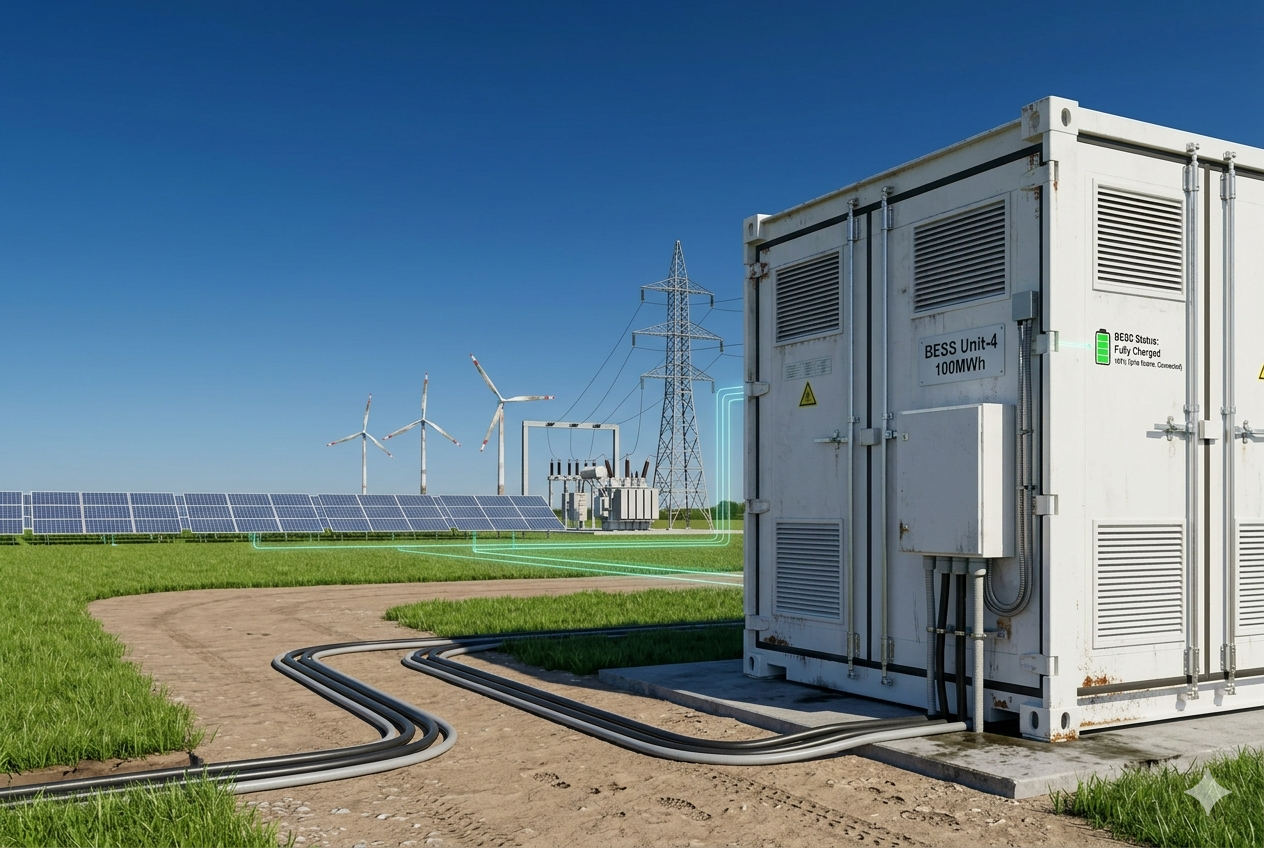
A Practical Framework Behind Successful BESS Investments
## Key Takeaways
– Energy storage projects are essential infrastructure assets in modern power systems.
– Developers evaluate energy storage projects based on revenue models, battery performance, system design, and regulatory conditions.
– Revenue stacking is a key factor that determines project profitability.
– Battery degradation modeling is critical for long-term financial forecasting.
– Successful projects require alignment between technology, market strategy, and system engineering.
How Developers Evaluate Energy Storage Projects
Energy storage projects are market-driven infrastructure assets that store electricity and generate value through multiple revenue streams such as energy arbitrage, grid services, and capacity markets. These projects play a critical role in enabling renewable energy integration and stabilizing modern power systems.As global renewable energy deployment continues to accelerate, battery energy storage solutions (BESS) are rapidly becoming a central component of modern electricity infrastructure.
Solar and wind generation are inherently variable resources. Without flexible assets capable of balancing supply and demand, power systems face increasing challenges related to curtailment, grid congestion, and electricity price volatility.
Energy storage addresses these challenges by providing dispatchable flexibility that stabilizes power networks and optimizes renewable generation.
However, evaluating an energy storage projects is fundamentally different from evaluating traditional power generation assets.
Conventional power plants often rely on a single revenue stream, such as electricity sales or capacity payments. In contrast, storage projects operate within complex electricity markets where profitability depends on multiple revenue streams, operational strategies, and regulatory frameworks.
As a result, developers typically evaluate battery energy storage investments using a structured framework that examines both market opportunity and long-term technical performance.
Key Factors in Energy Storage Projects Evaluation
Most developers evaluate battery energy storage projects across five key dimensions:In simple terms, developers evaluate energy storage projects across three core dimensions: market opportunity, battery performance, and system integration strategy. The combination of these factors determines whether a project can achieve stable long-term returns.
-
Revenue potential and market participation opportunities
-
Battery technology performance and degradation behavior
-
System architecture and grid integration strategy
-
Operational reliability and safety engineering
-
Regulatory environment and policy stability
Projects that perform well across these dimensions are far more likely to become bankable long-term energy infrastructure assets.
Revenue Models in Energy Storage Projects
For most developers, the evaluation process begins with a fundamental question:
How will the energy storage asset generate revenue over its operational lifetime?
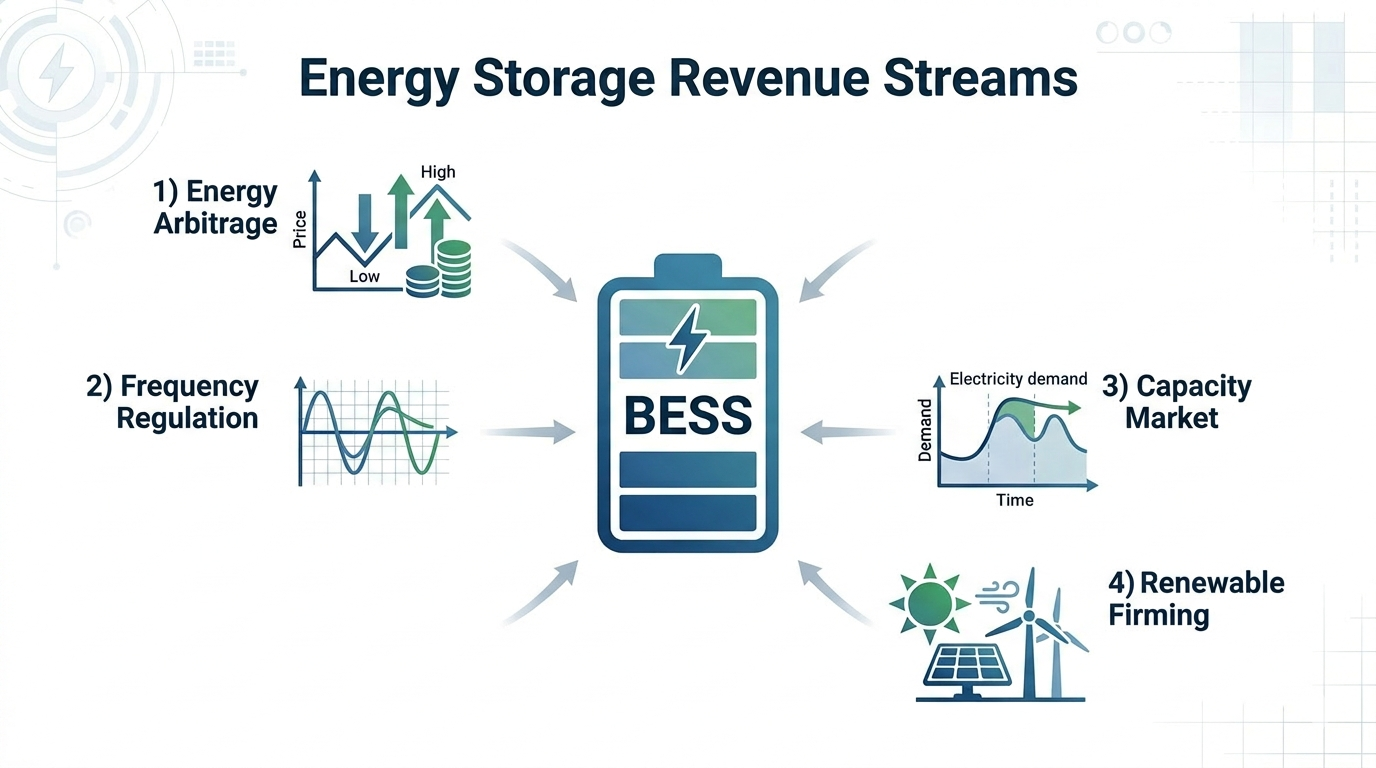
Energy storage is fundamentally a flexibility resource. Instead of producing electricity continuously, storage systems capture value by shifting energy across time, stabilizing grid operations, and providing reliability services.
Common revenue streams include:
• Energy arbitrage in wholesale electricity markets
• Frequency regulation and ancillary grid services
• Capacity market participation
• Demand charge management and peak shaving
• Renewable energy firming for solar and wind assets
In many electricity markets today, revenue stacking — the ability to combine multiple value streams — is a key determinant of project profitability.According to the International Energy Agency (IEA), energy storage will play a key role in future power systems.
Developers therefore rely on detailed market simulations that analyze:
-
price volatility
-
dispatch strategies
-
expected operating cycles
-
participation rules for different grid services
These models estimate potential annual revenue and determine whether a project can achieve acceptable returns under different market scenarios.
For solar-plus-storage projects, energy storage can significantly improve economics by shifting generation to higher-value periods and reducing renewable energy curtailment.
Battery Technology and Long-Term Performance
Once market opportunity is established, developers turn to the underlying battery technology.
Interestingly, developers are often less focused on peak performance specifications than on how the system performs over its full operational lifetime.
Utility-scale battery storage projects typically operate for 15–20 years, which means long-term degradation behavior has a direct impact on project economics.
Key technical factors evaluated include:
• Battery chemistry and safety characteristics
• Cycle life and degradation patterns
• Round-trip efficiency under real operating conditions
• Depth-of-discharge limits
• Thermal management system performance
Today, lithium iron phosphate (LFP) batteries have become the dominant chemistry in many large-scale deployments due to their strong safety profile, long cycle life, and thermal stability.
However, sophisticated developers go further by using battery degradation modeling to forecast long-term performance.
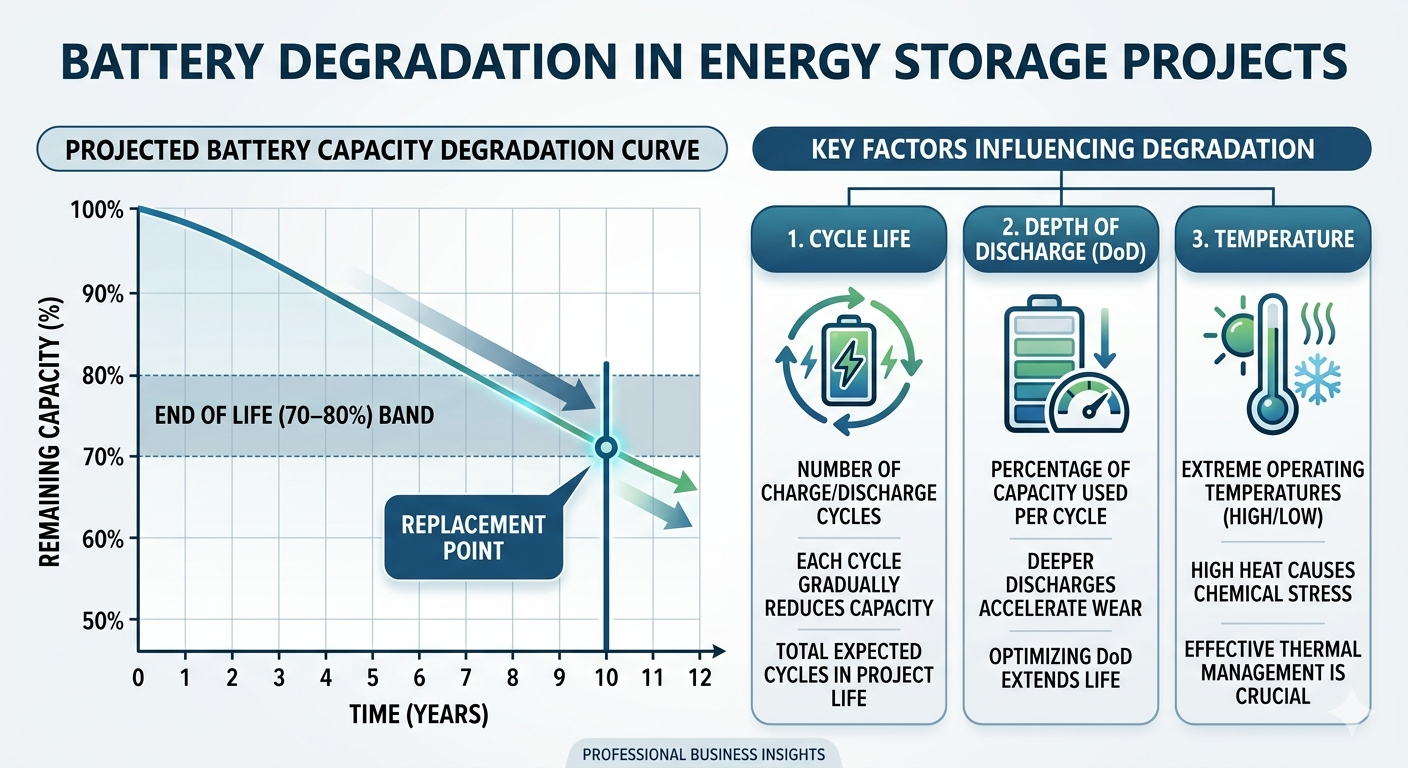
These models simulate:
-
capacity fade over time
-
efficiency loss across cycles
-
replacement schedules for battery modules
Such analysis allows project developers to incorporate realistic battery replacement costs into financial models, ensuring more accurate long-term revenue projections.
For lenders and institutional investors, these forecasts are essential for determining whether the storage project can maintain stable performance throughout its lifecycle.
System Architecture and Grid Integration
Battery energy storage systems rarely operate as isolated assets. Most projects form part of a broader energy ecosystem that includes renewable generation, grid infrastructure, and advanced energy management platforms.
Developers therefore carefully evaluate system architecture and integration strategy.
Important technical considerations include:
• Power Conversion System (PCS) efficiency and reliability
• Energy Management System (EMS) control capabilities
• AC-coupled versus DC-coupled configurations
• Grid interconnection requirements
• Integration with solar or wind generation assets
System architecture decisions significantly influence:
-
project capital expenditure
-
operational flexibility
-
system efficiency
-
long-term maintenance costs
For example, DC-coupled systems are often favored in hybrid solar-plus-storage projects because they reduce energy conversion losses and allow better utilization of solar generation.
In contrast, AC-coupled systems may offer greater flexibility when adding storage to existing renewable power plants or grid-connected infrastructure.
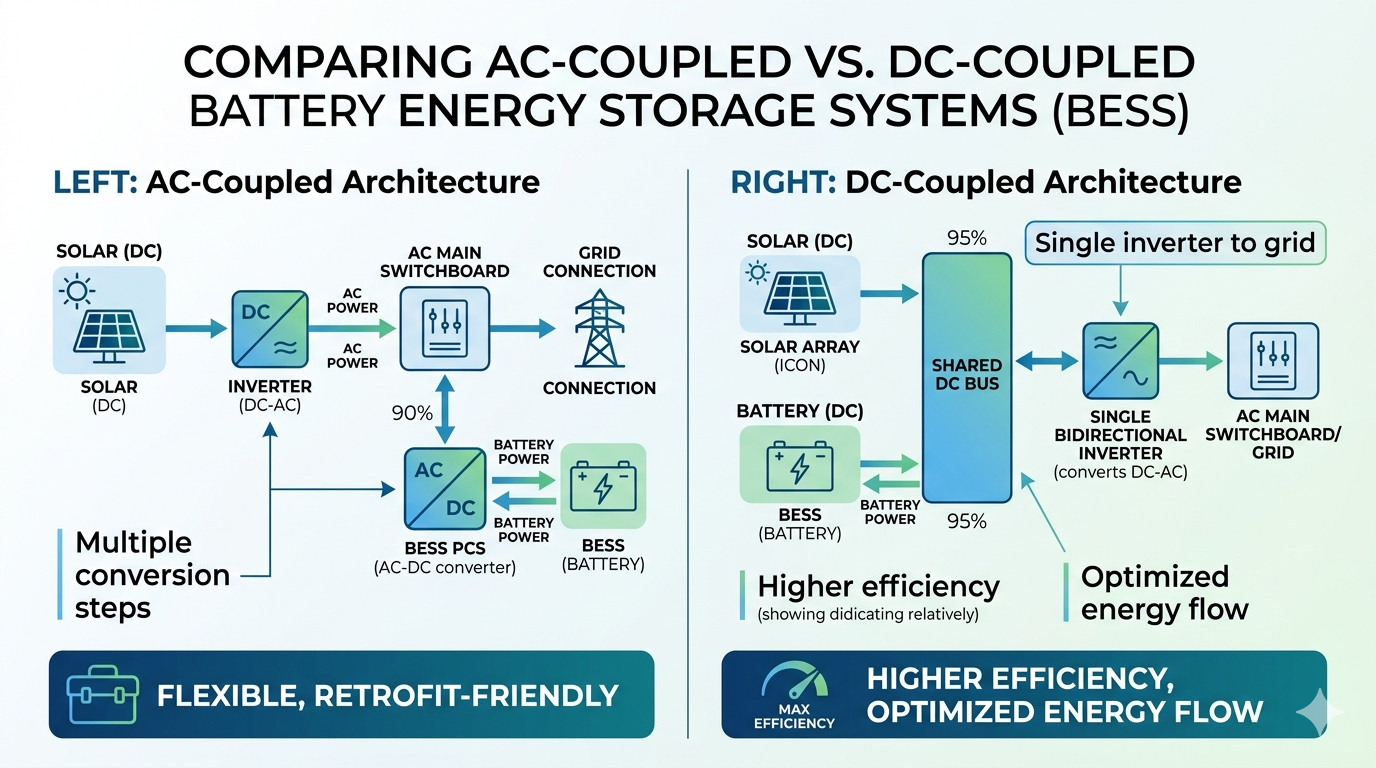
AC- and DC-coupled architectures differ significantly in efficiency, flexibility, and integration strategy, making system design a critical factor in energy storage project performance.
Selecting the optimal architecture requires balancing engineering design, project economics, and operational strategy.
Reliability, Safety, and Operational Risk
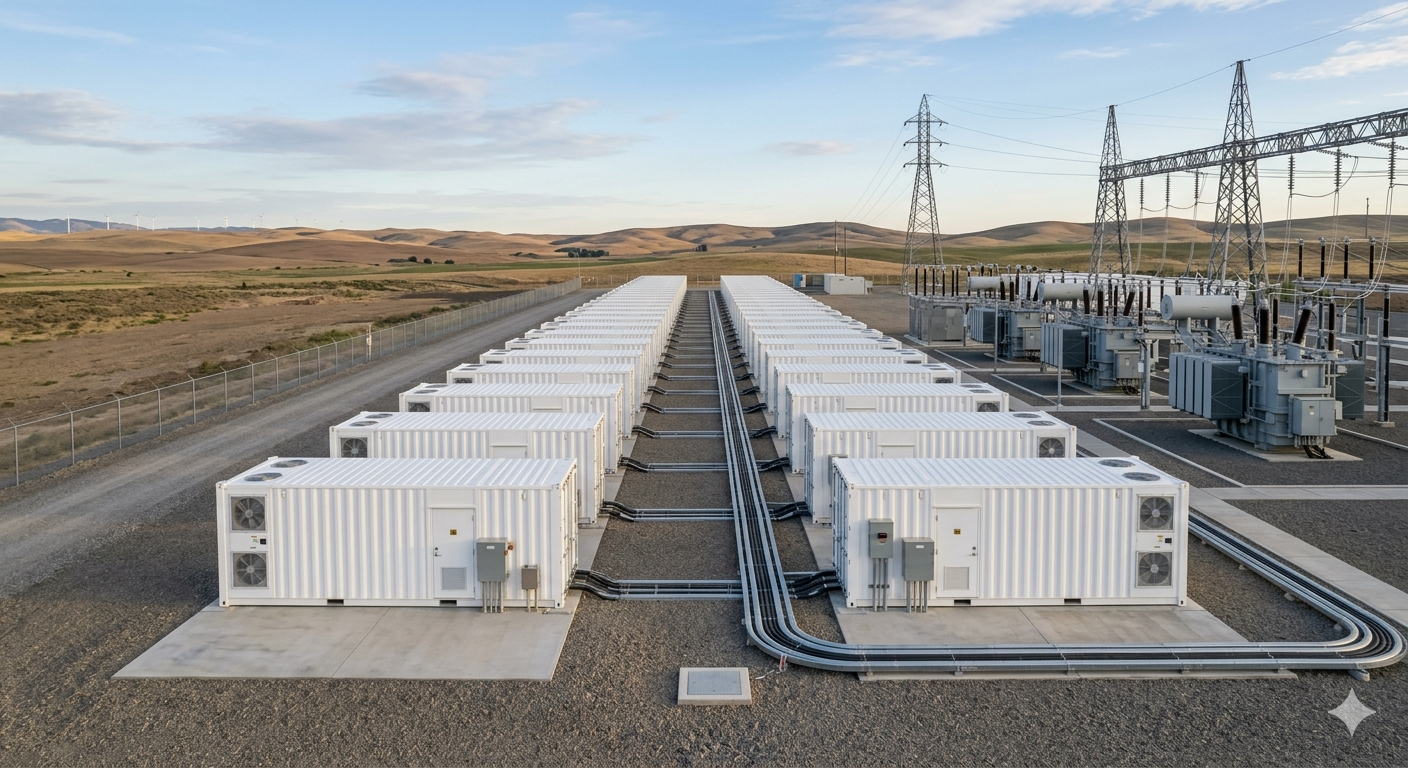
Battery energy storage systems are long-term infrastructure assets, and reliability plays a major role in project bankability.
Unlike traditional power plants, battery systems involve complex electrochemical processes and high energy density materials. Robust engineering design and safety management are therefore essential.
Developers and investors typically evaluate several critical risk factors:
• Battery safety certifications and compliance standards
• Thermal management reliability
• Fire detection and suppression technologies
• Engineering track record of the technology provider
• Warranty terms and long-term service agreements
For large-scale projects, lenders frequently require independent technical due diligence before financing is approved.
These assessments review system design, safety engineering, operational protocols, and supplier credibility.
In many cases, the ability to secure financing depends as much on risk mitigation measures as on projected revenue potential.
Regulatory Environment and Market Participation
The final dimension in evaluating an energy storage project is the regulatory environment.
Energy storage occupies a unique role in electricity systems. Depending on its application, it may function as:
-
generation
-
grid support infrastructure
-
demand-side flexibility
Because of this hybrid role, policy frameworks strongly influence project viability.
Key regulatory considerations include:
• Market access rules for storage participation
• Capacity market eligibility requirements
• Ancillary service market design
• Renewable integration policies
• Investment incentives, subsidies, or tax credits
Regions with well-defined market participation rules typically experience faster energy storage deployment.
Conversely, regulatory uncertainty can slow project development even when the underlying economics appear attractive.
For developers, understanding long-term policy stability is often just as important as evaluating current market conditions.
BESS Project Evaluation Checklist
Developers often apply a structured checklist when assessing a battery energy storage investment:
• Expected revenue streams and market access
• Electricity price volatility and dispatch strategy
• Battery cycle life and degradation modeling
• System architecture and integration complexity
• Engineering design and safety compliance
• Long-term service agreements and warranties
• Policy incentives and regulatory stability
Projects that perform well across these categories are more likely to secure financing and achieve commercial operation.
### Summary: Energy Storage Project Evaluation Framework
Energy storage projects are evaluated based on a structured framework that includes:
– Revenue potential and electricity market participation
– Battery degradation and long-term performance modeling
– System architecture and grid integration strategy
– Operational reliability and safety considerations
– Regulatory environment and policy stability
Projects that perform well across these dimensions are more likely to become bankable long-term infrastructure assets.
Conclusion: Turning Storage Projects into Bankable Energy Assets
Energy storage is rapidly becoming a cornerstone of modern electricity systems and renewable energy integration strategies.
However, from a developer’s perspective, successful storage projects require far more than simply deploying battery technology.
They depend on a careful balance between market opportunity, technology performance, system integration, operational reliability, and regulatory support.
Developers who evaluate these dimensions early in the project development process are far more likely to deliver storage assets that are both technically robust and financially sustainable.
As electricity markets evolve and renewable penetration continues to increase, this structured approach to project evaluation will remain essential for transforming promising storage concepts into bankable long-term infrastructure investments.
Frequently Asked Questions
## FAQ: Energy Storage Projects
### What are energy storage projects?
Energy storage projects are systems that store electricity for later use, helping balance supply and demand, improve renewable energy utilization, and enhance grid stability.
—
### How do developers evaluate energy storage projects?
Developers evaluate energy storage projects by analyzing revenue streams, battery performance, system architecture, operational risk, and regulatory conditions.
—
### What are the main revenue streams for energy storage projects?
The main revenue streams include energy arbitrage, frequency regulation, capacity markets, demand charge reduction, and renewable energy firming.
—
### What affects battery degradation in energy storage systems?
Battery degradation is influenced by cycle life, depth of discharge, temperature, and real-world operating conditions.
—
### Why are energy storage projects important for renewable energy?
Energy storage projects enable higher penetration of renewable energy by stabilizing power systems, reducing curtailment, and improving energy dispatch flexibility.
—
### How long do battery energy storage systems last?
Most utility-scale battery energy storage systems are designed to operate for 15 to 20 years, although battery modules may require replacement depending on usage patterns.
Planning an Energy Storage Project?
Developing a successful battery energy storage project requires careful evaluation of technology selection, system architecture, and market participation strategy.
Whether you are planning a solar-plus-storage project, standalone BESS system, or hybrid renewable development, our team can help analyze system design and key technical factors that influence project performance.
Feel free to contact us to discuss your project requirements or explore potential solutions.
As global energy systems transition toward low-carbon solutions, energy storage projects are increasingly recognized as essential infrastructure for enabling a flexible, reliable, and resilient power grid.